
 Alyssa Summers
Montgomery County has begun construction in Colesville, Maryland, on the first of six childcare facilities to address the county’s lack of spots for infants.
The new $12.7 million development will replace the aging Horizon Child Care center at Martin Luther King Jr. Recreational Park.
However, this expansion of childcare spaces isn’t expected to reach Bethesda, where some parents reportedly pay more than their rent for tuition. And even if it did, the additional capacity wouldn’t address the cost of childcare burdening many Bethesda parents.
In Bethesda, expanding childcare access requires more than new facilities. High commercial rents, labor shortages that drive up wages, and a strict 3-to-1 infant-to-adult ratio create additional barriers to expanding care. Some childcare executives describe the industry as “complicated and messy.”
Maryland Daycare Licensing Regulations mandate the 3-to-1 ratio to enhance safety and cap each infant classroom at six children, regardless of how many adults are present. As a result, childcare facilities must hire a large staff to remain compliant with the legal limit, hiking up local costs for care in order to cover payroll.

Jennifer Arnáiz, the senior administrator of Early Childhood Services at the Montgomery County Department of Health and Human Services, said the biggest barrier for an infant program is the operational cost.
“The business model is reliant on what parents pay for tuition, but that doesn’t necessarily make ends meet for the program to be sustainable,” Arnáiz said.
According to Arnáiz, the average market rate for an infant placement is around $20,000 a year, compared to the cost of that seat for the program, which sits around $26,000 per year.
“I’ve heard parents putting their names onto a waitlist before they’re even pregnant,” Arnáiz said. “And if you do get a seat, can you afford it?”
Bethesda is different from the rest of Maryland when it comes to childcare: Two-thirds of the childcare providers are large, commercial childcare centers that cost almost $1000 more per month compared to home childcare centers.
Parents like Reddit user @bbwabba, a mother of five living in downtown Bethesda, said on the subreddit r/bethesda she couldn’t find any childcare that cost less than her rent for the month, forcing her to go to a small in-home daycare in Silver Spring, Maryland.
This is common for many families who use the I-270 corridor to enroll their child at centers outside of Bethesda proper and save about $8,400 per year, according to a 2026 market overview of Montgomery County by Daycare Cost Guide.
In October 2025, Montgomery County launched a $4 million Early Care and Education Facility Loan Program to provide forgivable loans to families to help with daycare tuition and offers zero-interest loans to local childcare providers for facility renovations and expansions.
For Maryland families, this program paid providers the market rate up front, leaving them with co-payments as small as $3 per week. However, recent demand as of July 2026 caused the state to institute a partial enrollment freeze and create a waitlist with limited spaces.
The program’s first funding cycle for providers drew more than 100 applications, but only 19 projects were selected for the initial $2.268 million.
The program selected twelve family childcare providers and seven larger centers, with plans to create 178 new licensed infant and toddler seats across the county.
David Dise, the director of Montgomery County’s Department of General Services, said specific addresses or timelines for the remaining five locations are still moving through the county’s design and budget approval processes. He said officials are not currently looking at Bethesda as they respond to the needs presented to them.
Even if future expansion reaches Bethesda, however, additional childcare facilities do not necessarily mean tuition will become affordable.
According to a 2024 report from the Maryland comptroller, operating margins of less than 1% leave childcare providers with little flexibility to lower tuition. Additional facilities can increase demand for qualified infant teachers, pressuring wages, which parents eventually pay.
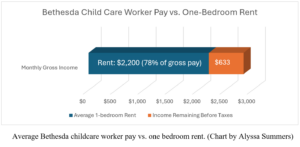
ZipRecruiter 2026 market data shows that childcare workers make an average of $16.46 an hour, or about $34,000 annually; 80% of this is consumed by the average monthly rent for a one-bedroom apartment in Bethesda proper.
Analysis from the same 2024 comptroller report found that the high cost of living in Maryland’s most expensive areas severely complicates recruitment and retention efforts for suburban providers, particularly for those workers who cannot afford to live near their jobs.
Rock Spring Children’s Center in North Bethesda is a non-profit childcare franchise that completed a major expansion last year and charges $3,100 per month for infant care. It offers a different perspective.
The center’s executive director said that since the upgrades, it has not experienced issues with staffing, capacity, or waitlists, even with an annual 5% increase in tuition.
“We don’t have waitlists as we’ve had since the pandemic,” said Carrie Meyer, the executive director of Rock Spring. “If someone called today, I’d be able to accommodate them.”
While Rock Spring said it can accommodate families, Arnáiz said an available seat does not necessarily mean childcare is affordable or sensible for every Bethesda family.

 Ashayla Byrd
 Hiba Alkhersam
 Isabella Barias


Add comment