
 Celeste Hoytt
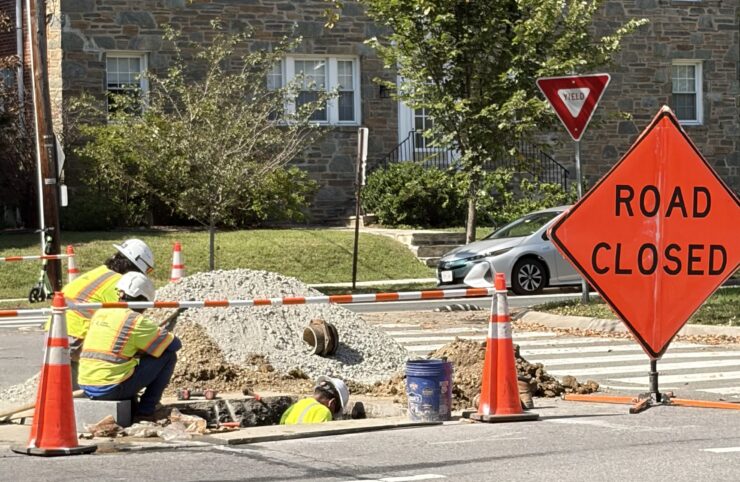
Crews will start relining hundreds of sewer pipelines across Del Ray East this fall, a yearlong project that will bring water shutoffs, lane closures, and parking restrictions to neighborhoods east of Commonwealth Avenue in Alexandria.
Some residents and business owners say the city has left them in the dark about the details they need to prepare.
The Del Ray East Sanitary Rehabilitation Project aims to repair aging infrastructure, prevent sewage overflows, and stop leaks in the sewer lines.
According to the official city website, Alexandria is rehabilitating 373 city-owned sewer laterals, the pipes that connect homes and local businesses to the main line between Commonwealth Avenue and Route 1. Pleasants Cos. is the contractor on the $4.08 million project, which is scheduled to be completed fall 2027.

The work is part of the city’s Sanitary Sewer Asset Renewal Program, which began in 2021 to inspect and repair aging sewer lines. City inspections found 491 of the area’s 2,611 laterals needed rehabilitation. This contract with Pleasants Cos. covers 373 laterals, though the city did not say what will happen to the rest.
Construction is scheduled to begin this month, but city officials have not given an exact date when crews would reach specific streets.
Because the pipes are repaired from the inside, crews will avoid digging, but residents will need to move their cars, limit water use, and plan around construction from 7 a.m. to 6 p.m. on weekdays and 9 a.m. to 6 p.m. on Saturdays.
Residents will receive two notices before work reaches their block, but some neighbors say that isn’t enough warning.
One of them is Margaret Janowsky, who owns Del Ray Cafe and is treasurer of the Rosemont Citizens Association. She said the city too often relies on occasional online posts to announce major projects, and that many residents never see them.
“You can’t just rely on the city’s e-news. Most people don’t read that, especially the older community here. It’s not a reasonable approach for the people that are the most impacted,” Janowsky said.

She said the city should send information directly to residents so that they are able to prepare weeks or months in advance.
“You need physical postcards or something. You need to give people more information. More is better. I don’t want to hear about the meeting after it happened,” said Janowsky.
Janowsky said she learned about the project from an initial post on The Zebra, an independent local news source in Alexandria, not from the city.
“How did we not know about this? It’s not rocket science. What if it was happening in front of your house? Wouldn’t you want to know what’s going on?” Janowsky asked.
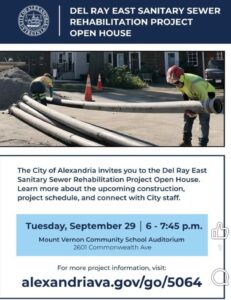
The city held an open house to discuss the work on the evening of Sept. 29 at Mount Vernon Community School. Residents who attended said they were unaware of the project’s lengthy timeline.
“We had no clue this was happening,” said Jacob G., a longtime Alexandria resident who asked for his full name not to be used for privacy reasons. “It’s not a small project; it’s going to the take a year. I think the city should have done a better job at alerting us ahead of time.”
At the open house, city staff said residents on affected blocks will get two notices, in English and Spanish. Lu Zhang, a civil engineer with Alexandria’s Department of Transportation and Environmental Services, said the first notice will go out about two weeks before crews arrive and the second 48 hours before.
City officials said they are working to help residents prepare.
“This project needs to happen, but we are trying our best to let neighbors know how to prepare for it,” Zhang said.
Ayoub Hassen, the city’s construction project manager, said the notices are meant to help people plan their schedules. According to the city’s open house material, the notices will describe the construction and how it will affect residents directly.
“We don’t want the community to feel blindsided. This is why we hosted the open house for the community, so they are able to ask us important questions,” said Hassen.
How the lining works
Instead of digging up the entire street to replace old pipes, construction crews will repair them from the inside. The process, called cured in place pipe lining, or CIPP, starts with a camera filtering through the pipe to find breaks or cracks.

Crews then feed a flexible liner soaked in resin into the old pipes through an access point. An inflatable tube is pressed against the pipe wall, and hot water hardens the resin to close the openings. When the tube is removed, a new pipe is formed inside the old pipe.
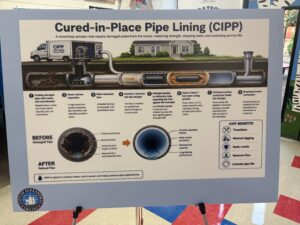
Because the city is using this type of construction over invasive digging, the city said surface disruption is minimal. However, the lining must cure before the pipe can be used again, which is why households will be asked to limit their water use.
Timeline of Project
Zhang said the work will move through the neighborhood in four phases.
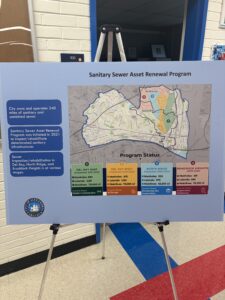
Del Ray East will be finished first and is under construction, with work scheduled to end in fall 2027. The design for work in Del Ray West has been completed and construction is planned once Del Ray East work is done.
Officials are reviewing North Ridge inspection results and conducting inspections in Braddock Heights.
Zhang said residents are able to see if their homes or businesses will be impacted during Phase I construction by viewing the Design Plan on the project site, specifically pages 30 through 32.
“We’ll have a separate open house for construction in Phase II, and design plans will also be shared with the public,” said Zhang.
Guide for Residents
| Hours and traffic | Parking & Towing | Water Limits | Noise | Odors |
|---|---|---|---|---|
| Work will run from 7 a.m. to 6 p.m. Monday through Friday, and 9 a.m. to 6 p.m. on Saturday.
On Commonwealth Avenue, Mount Vernon Avenue, East Glebe Road, and East Monroe Street, weekday work is limited to 9 a.m. to 3:30 p.m. with periodic lane closures near work zones. |
No-parking signs on the streets directly impacted will go up 72 hours before work begins.
“People normally listen to the no-parking signs we put on the street, but if their car gets towed because they forgot to move it, we will work with law enforcement to temporarily move the car to a safe location,” said Hassen. |
Water service will be temporarily suspended, for around six hours. Notices will go up ahead of time on the impacted block so that neighbors are informed on specific times to limit use while the liner cures.
“We ask that neighbors limit their water usage during this time by limiting chores that use more water such as doing their laundry, running dishwashers, and cutting back on showers,” said Zhang. |
Residents should expect normal construction noise during daytime hours.
“Our aim is not to disrupt our neighbors, but they may hear some disruptions such as humming or buzzing noises from the equipment,” said Hassen. |
According to a study by the Centers for Disease Control and Prevention, CIPP creates a potent chemical smell during the curing process which stems from styrene, an organic compound that is the base liquid for the resin. Although typically harmless in small concentrations, the CDC cautions sensitive groups to avoid the direct area as it can cause respiratory irritation, dizziness, and prolonged headaches.
Because the chemical vapors can travel up the lateral and escape into indoor spaces through unsealed floor drains, Zhang said, “I would advise pouring water into drains that do not get frequently used to prevent chemical smells entering the home.” |
Hours and traffic
Work will run from 7 a.m. to 6 p.m. Monday through Friday, and 9 a.m. to 6 p.m. on Saturday.
On Commonwealth Avenue, Mount Vernon Avenue, East Glebe Road, and East Monroe Street, weekday work is limited to 9 a.m. to 3:30 p.m. with periodic lane closures near work zones.
Parking & Towing
No-parking signs on the streets directly impacted will go up 72 hours before work begins.
“People normally listen to the no-parking signs we put on the street, but if their car gets towed because they forgot to move it, we will work with law enforcement to temporarily move the car to a safe location,” said Hassen.
Water Limits
Water service will be temporarily suspended, for around six hours. Notices will go up ahead of time on the impacted block so that neighbors are informed on specific times to limit use while the liner cures.
“We ask that neighbors limit their water usage during this time by limiting chores that use more water such as doing their laundry, running dishwashers, and cutting back on showers,” said Zhang.
Noise
Residents should expect normal construction noise during daytime hours.
“Our aim is not to disrupt our neighbors, but they may hear some disruptions such as humming or buzzing noises from the equipment,” said Hassen.
Odors
According to a study by the Centers for Disease Control and Prevention, CIPP creates a potent chemical smell during the curing process which stems from styrene, an organic compound that is the base liquid for the resin. Although typically harmless in small concentrations, the CDC cautions sensitive groups to avoid the direct area as it can cause respiratory irritation, dizziness, and prolonged headaches.
Because the chemical vapors can travel up the lateral and escape into indoor spaces through unsealed floor drains, Zhang said, “I would advise pouring water into drains that do not get frequently used to prevent chemical smells entering the home.”
Who to Call for help
Construction concerns: Ayoub Hassen, construction project manager, 703-746-4635, ayoub.hassen@alexandriava.gov
Program questions: Lu Zhang, civil engineer, Transportation and Environmental Services, 703-746-4289, lu.zhang@alexandriava.gov
Contractor: Eddie Lezcano, project manager, Pleasants Companies, 240-726-4507
Project information: alexandriava.gov/go/5064
City staff did not say what happens if the project runs over schedule or budget. Zhang said the projected timeline is reasonable for the planned work.
When asked why previous projects in the city had gone over the projected schedule, Zhang said, “Those took longer because we had partnerships with private owners and had to ask permission to work on the sites. We already have the permission needed for Phase I.”
Janowsky said the city’s communication with residents needs to improve for large scale projects.
“This is a really, seriously great project but we had no clue. The city has gotten really bad at communicating with us,” Janowsky said.

 Deona Easterson
 Antoine Sanfuentes
 Hiba Alkhersam


Add comment