
 Makyla McLeod
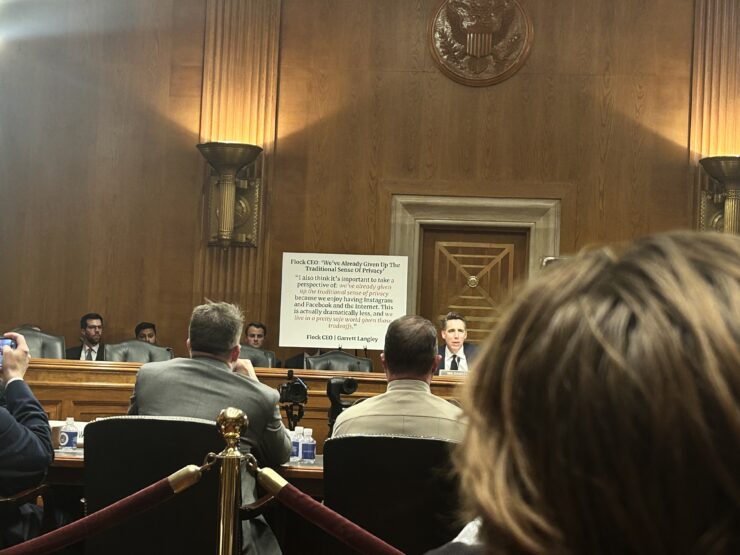
Calls for regulation and guardrails on products such as Flock Safety license-reading cameras drew bipartisan support last week from lawmakers in a senate judiciary subcommittee hearing.
As public outcry gains momentum, Sen. Josh Hawley, R-MO, chair of the Judiciary Subcommittee on Crime and Counterterrorism, raised privacy concerns regarding data collection. Lawmakers called for regulation and transparency from companies such as Flock Safety, which produce automated license plate readers that capture driving data. They are primarily used by police.
“We’ve got to find a way to protect and enforce the Bill of Rights and the basic, personal liberties of every law-abiding citizen in this country. No matter what the technology is,” Hawley said.
Policy advocates and law enforcement experts testified primarily on the risks posed by AI-driven automatic license plate readers, or ALPRs.
The committee invited the CEOs of Flock Safety and similar manufacturing entities, including Axon, Motorola Solutions and Verkada to testify, but none were in attendance.
Charges of misuse
Multiple reports of misuse have increased national dissent, including an incident involving witness Lindsey Isaacs, who testified she spent 13 days in jail and faced life in prison after being misidentified by a Flock camera as a hit-and-run driver. The state of Florida ultimately declined to prosecute Isaacs.
Chad Marlow, senior policy counsel for the American Civil Liberties Union, testified before the committee that the technology’s capabilities for surveillance pose a significant threat, questioning if regulation of the cameras would be enough.
“If you build it, they will come,” Marlow testified. “When you create the option for population control, at some point, someone’s gonna use it.”
While license plate readers have been broadly used since the late 1990s, AI-driven license plate readers are much more recent. Cameras, like those operated by Flock Safety, have been drawing concerns nationwide over collected data and the limited regulation of access to their nationwide database.
With 120,000 cameras currently installed by Flock along urban and rural streets and highways, the cameras operate 24/7, collecting images of all passing vehicles, according to a report by the ACLU. The cameras obtain all observed data, from vehicle make and model to bumper stickers and scratches.
The nationwide database has a feature which allows subscribers to reconstruct movement, document patterns and gather related information via identifiable details in images, according to multiple hearing witnesses.
“We have gone way out of balance,” said Sen. Cory Booker, D-NJ. “In fact, we are out of control for any government – state, local or federal – to easily abuse the fundamental rights that we all assume we have a right to.”
A primary concern for legal experts is the use of the technology without community input.
Matthew Cavedon, director of the Project on Criminal Justice at the Cato Institute, emphasized that the access of Flock and other ALPR surveillance systems should be “treated like other significant intrusions on people’s privacy.”
“There needs to be limits on when this stuff is activated, how much is retained and who can access it,” Cavedon told the Wash.
As federal legislators and industry experts weigh the benefits and drawbacks of the technology, others say that the need to respond to current risks is imminent.
“This technology is new,” said Cavedon. “However, Americans and American law have always had to adapt to changing circumstances and changing technology.”

 Ashayla Byrd
 Alyssa Summers
 Hiba Alkhersam


Add comment