
 Jacob Saucier
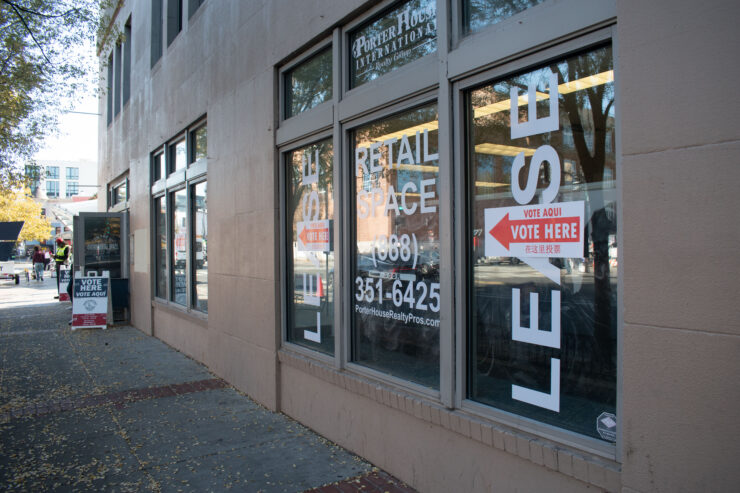
As voters across the country cast ballots on Tuesday to determine control of Congress, some D.C. residents are frustrated that the outcome of an election with significant consequences for their city remains largely outside their control.
“I want Janeese to win, but it felt pointless. We don’t have a real representative. I guess I’m hoping everyone outside of D.C. does their part,” said a college-aged voter who declined to be identified.
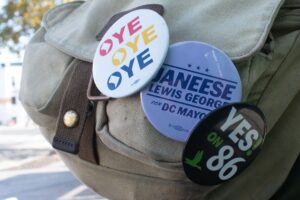
The voter was referring to Democratic mayoral candidate Janeese Lewis George, who is seeking to succeed outgoing Mayor Muriel Bowser after the latter announced she would not run for a fourth term.
In addition, D.C.’s current non-voting congressional delegate, Eleanor Holmes Norton, is not running for reelection this year. Her expected replacement, Democrat nominee Robert White, stepped down from his seat on the D.C. Council yesterday, Nov. 2, to remain eligible for today’s election.
Under the U.S. Constitution and the 1973 Home Rule Act, Congress has the power to review and overturn local legislation, impose policies on the district, and restrict local spending.
D.C. residents are dependent on the congressional elections of other states to determine who will control the federal legislature that oversees their city.
Federal intervention weighs on voters
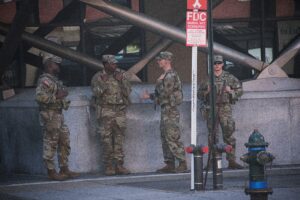
For some voters in Ward 1, the Trump administration’s deployment of the National Guard in the district has made federal policy direction a particularly pressing concern.
“We need representation. We don’t need the National Guard here. I can’t wait two more years for a government that works,” said Joseph, a voter who declined to give his last name.
Unlike state governors, the D.C. mayor does not command the district’s National Guard. Instead, that authority rests with the president, giving the federal government a uniquely direct role in the city’s policing.
Another college-aged voter, who declined to be identified, said the National Guard’s presence is contributing to growing calls for D.C. autonomy, a cause he supports.
He said the guards’ deployment has been a major motivating issue for the Free DC movement, which advocates for greater local self-government.
The voter said he believed D.C. should have a say in how the federal government oversees the district. “The fact that we don’t have control over the nation guard is crazy,” he said.
The results of Tuesday’s congressional elections could affect how lawmakers approach federal oversight of the district, but a blue swing would not automatically end the National Guard’s deployment.
Hopes for political change
Several voters interviewed Tuesday said they hoped Democrats would gain control of Congress.
“I’m hoping for nothing short of a blue tsunami,” said a woman who declined to be identified.
A man who also declined to be identified, said, “I hope that people see that the Republican agenda isn’t real.”
A Howard University student expressed similar hope for a Democratic victory but questioned whether the outcome would loosen federal control over the district.
“My hopes are obviously that blue takes the election. I don’t think they’ll take the National Guard out, though,” she said.
The Howard student also said she was frustrated by her inability to vote in both the district and congressional elections while attending college away from her home state.
“It’s encouraging that seeing how many college students voted near Howard when they couldn’t go home to vote, but it’s irritating that I can’t vote in the federal election because I go to college here, and they lost my mail-in ballot in my home state,” she said.
Younger voters look toward future elections
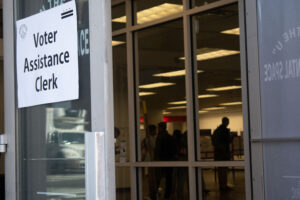
Howard University students came to vote independently and in large groups. Howard students emphasized the importance of participating in the electoral process, even as some were unable to cast ballots themselves.
Three Howard freshmen said they were disappointed to have narrowly missed the 18 year-old age cutoff for voting since they had been frustrated to learn that D.C. lacks voting representation in Congress; but they remained enthusiastic about participating in future elections.
“I’m not the best public speaker but I really hope there’s change,” said another Howard student.
For other residents, concerns extended beyond congressional representation and federal intervention to the rising cost of living.
One voter recalled earning $4.50 an hour years ago and called for raising the minimum wage to $25 an hour.

 Ashayla Byrd

 Birchard Allen
 Makyla McLeod


Add comment