
 Deona Easterson
Earlier this summer, Claire Silvera was going for her usual morning run on the Metropolitan Branch Trail near NoMa when a group of eight teenagers on scooters intentionally swerved into her space, forcing her off the trail.
“I have not been back since,” said Silvera.
Now a new mother, she said she worries about what could happen if she were to bring her daughter along on a run.
Silvera’s experience comes amid broader concerns about confrontations between pedestrians and people riding scooters or e-bikes in public spaces, particularly teenagers.
Recent incidents reported in Washington have raised concerns about pedestrian safety and the enforcement of these riders, bringing into question how the city can address these dangerous riding incidents while ensuring young people have access to safe community spaces.
Although D.C. police don’t formally track crimes involving ebikes and scooters, instances like Silvera’s have been on the rise.
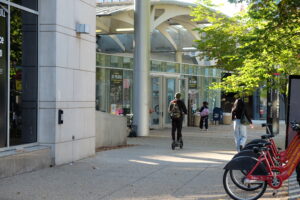
Earlier this month, a man in D.C. was surrounded by a group of teens on bikes while scootering in NoMa. Corbin Richardson was then pushed off his scooter and taunted by the teens, according to WUSA9. He sustained minor injuries, including a scraped knee and sore shoulder.
In the same week, 50-year-old Talib Shakir, director of the D.C. Mayor’s Office on Returning Citizen Affairs, died in a crash involving two electric scooters.
Although electric scooter and bike accidents have been a major concern, residents feel that teenagers have largely contributed to the lack of safety they experience in the neighborhood.
“The teenagers have taken over,” said William Foster, a longtime resident of the NoMa community.
Foster said he doesn’t go out at night anymore because he feels uneasy around large groups of teenagers whose behavior he considers unpredictable. He said that in recent months he has witnessed young people pushing and, in some instances, robbing others.
Silvera said she doesn’t want the teens to be at blame, and most of the community agrees.
“I’m so torn. I don’t want to be that person that’s like ‘Those damn kids!’ I don’t think anyone does because you understand where it’s coming from,” said Silvera.
Foster said he believes the issue reflects broader generational and socioeconomic challenges, including racial disparities.
“It’s not the kids, it’s what they are going through. It all starts in the home,” Foster said.
Connie Adams said she sees the issue as systemic. She said that greater economic security—including reliable access to food, housing, and basic needs—could help address some of the underlying challenges. She suggested universal basic income as one possible approach.
Adams has been visiting for the week and experienced some of these instances in her short stay here. She said when she walked out of her hotel the night before, a group of young people were smashing glass bottles against the walls and windows of buildings.
During an interview with Adams, a reporter for The Wash witnessed teens drive a car into another parked vehicle while a group of young people nearby laughed at the situation.
Despite their concerns, some residents said they want the city to focus on providing young people with more constructive ways to channel their time, energy, and skills.
Foster suggested expanding apprenticeship opportunities, while Silvera said she’d like to see a federal-level implementation that gives students the opportunity to work and experiment with different skill sets before making decisions about college or careers.
They said they want to see opportunities, like internships, that are often accessible to youth with more financial resources or connections, offered to children with fewer resources.
Parents want their children in afterschool programs too. According to the Afterschool Alliance, parents of more than 75,000 children and youth in Washington, D.C., want their children to attend an afterschool program.
But only half of them are in one, leaving a huge gap in the demand.
According to the same 2025 study, 68% of children would participate in one.
Foster said we need to start offering support and attention to these groups of teenagers to prevent more electric scooter and bike incidents like these.
“You can’t ignore it. It’s happening, and it’s getting worse,” said Foster
 Isabella Barias
 Alyssa Summers
 Birchard Allen


Add comment