

 Deona Easterson
A 1980s-era video privacy law has protected viewers’ data for decades. But a Supreme Court case argued in October concerned a potential loophole that could allow media companies to secretly track and distribute what you watch online.
Sports fan Michael Salazar claimed that his privacy was violated in 2022 when Paramount Global shared his video viewing history with Facebook. Salazar claims his data should have been protected under the Video Privacy Protection Act of 1988.
The law was enacted after a newspaper published the records of what movies were rented at a local video store by then U.S. Supreme Court nominee Judge Robert Bork. The violation of personal viewing habits sparked outrage and prompted Congress to enact the Video Privacy Protection Act. (Bork’s nomination was rejected, but not because of the videos.)
The act barred a “video tape service provider” from “knowingly disclos[ing], to any person, personally identifiable information concerning any consumer of such provider.”

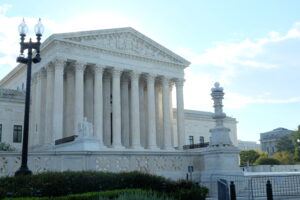
On Oct. 14, the justices heard oral arguments from lawyers representing Michael Salazar and Paramount Global to determine if the law requires a post-TikTok-era rebranding.
The question is who qualifies as a “consumer” under this law and whether its protections extend to people who subscribe to other services offered by a company that provides videos.
In 2022, Salazar signed up for an email newsletter from 247Sports.com, a Paramount-owned company that covers college sports recruiting.
While browsing the sports site, Salazar had Facebook open in another tab and was signed into his personal account.
The lawsuit alleges that, unbeknownst to Salazar, the Paramount-owned company had a hidden code installed on its website that sent data revealing who he was and what he watched straight to Facebook the moment he hit “Play” on a video.
Salazar argues that his newsletter subscription made him a “consumer” of the site, protecting his viewing data under the 1988 law.
However, lower courts in Tennessee rejected his claims because he was not the right type of “consumer” to fall within the protective policy’s ambit.
What counts as a consumer?
Paramount Global argues that a “consumer” should be someone who purchases video services, specifically, rather than someone who buys an unrelated service from a company that also provides videos.
Paramount’s lawyer, Paul Clement, told the court it doesn’t make any sense to “mix and match what makes you a consumer.”
Justice Amy Coney Barrett pressed Salazar’s lawyer, Joshua Hammack, on the limits of his interpretation.
“Would you take the position that if Chick-fil-A had some videos on its website, it’s a videotape service provider?” Barrett asked.
Hammack argued that the law requires a company to be engaged in the business of selling audiovisual materials, distinguishing Paramount’s business from a restaurant that happened to post videos online.
“Congress wrote this statute so that sort of clever structure by a provider won’t create a loophole,” said Hammack.
Paramount argued that expanding the term “consumer” to include someone purchasing non-video services from a site could create far-reaching problems for non-video retailers that host videos on their websites.
But Tom McBrien, legal counsel at the Electronic Privacy Information Center, said those concerns are “really, really overblown.”
McBrien disputed the argument that protecting Salazar under the law would “upend the entire internet advertising ecosystem.” He said the law contains exceptions that allow “a ton” of advertising to happen, “especially when what is being shared out is anything other than a literal record of which videos you watched.”
Could consent resolve the dispute?
Hammack argued that the case should not be escalated to complex, hypothetical consequences when, in his view, the core issue could have been avoided by simply getting consent from the user.
“Consent is such an easy fix,” said Hammack.
Justice Brett Kavanaugh asked how that consent would work in practice, and Justice Elena Kagan weighed in.
“It’s just one of those cookies boxes that comes up right? Wouldn’t you do it the exact same way?” asked Justice Elena Kagan. “I mean, we do that a thousand times a day.”
Clement pushed back on the idea that obtaining consent would be simple and said he sees it as a hassle that may involve putting up a “paywall.”
There is a cost to the “free” material you get on a website. Clement said that users pay for it by giving their data to companies, which is used to create targeted ads that drive up sales.
Kagan questioned why companies could not simply obtain consent or face the alternative: stop sharing users’ private information.
“Going forward, you have two very simple solutions. One is to get consent. Easy enough. People do it every day. And the other is to stop selling people’s private information. Take your pick,” Kagan said.
A decision is expected by the end of the Supreme Court’s term.

 Nia Ames
 Jacob Saucier



Add comment