
 Deona Easterson
 Antoine Sanfuentes
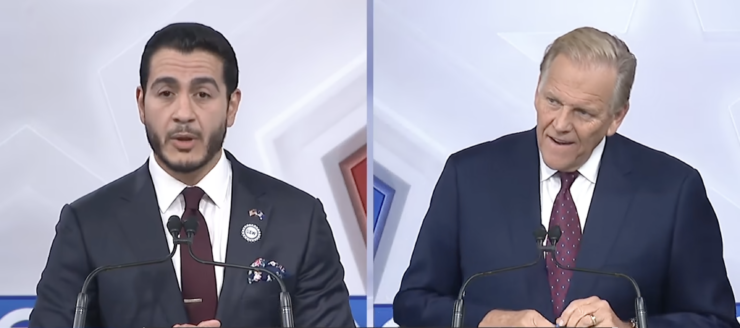
With the midterm elections just days away, Republican Mike Rogers continued to tie Democrat Abdul El-Sayed to extremist organizations during a contentious second debate between the Michigan candidates.
“Are you for America or are you for these terrorist groups overseas?” Rogers asked Democratic candidate El-Sayed at the beginning of the debate. If elected, El-Sayed could become the nation’s first Muslim senator.
Rogers once again questioned El-Sayed’s citizenship in the debate, accusing El-Sayed of lying about his citizenship and claiming he was “bought off by the Muslim Brotherhood.”
El-Sayed strongly denies having any ties to the Muslim Brotherhood. Fact-checks from Bridge Michigan state that there is ”no direct evidence for Rogers’ claim that El-Sayed had ‘pledged his support to the Muslim Brotherhood.'”
The exchange is part of a broader series of attacks from Rogers and GOP lawmakers on El-Sayed’s identity and alleged ties to extremist groups, including comments from President Donald Trump.
Trump has recently mocked the pronunciation of El-Sayed’s name, and in a fiery post one day before the Oct. 8 debate, Trump referred to the Democratic candidate as “Mohammed.”
“Mohammed goes back to the days of the Jihad. He is a RADICAL Extremist, Terrorist Sympathizer,” Trump wrote on Truth Social.
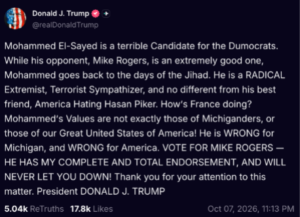
El-Sayed’s full name is Abdulrahman Mohamed El-Sayed, but he has been known as “Abdul” since before preschool, according to his book “Healing Politics,” raising the question of why Trump chose to refer to him by this name.
“He is trying to reinforce the idea that someone with an Arabic name, an index of the Muslim faith, is somehow less American than people with Christian and White/European names.” said Jennifer Sclafani, an assistant professor at the University of Massachusetts Boston, whose work focuses on identity and language in political discourse.
The remarks came amid a broader shift American attitudes toward Islam, with negative perceptions of the religion more than doubling in recent years.
Pew Research reported that the share of Americans who said Islam is more likely than other religions to encourage violence was at 25% in 2002. In 2026, that number jumped to 51%.
Language that questions opponents’ identities and affiliations, like the attacks seen in the Michigan Senate race, serves to “sow fear among white voters,” Sclafani told The Wash. She describes the tactic as creating an “us versus them” and “good versus evil” divide.
“It goes back to his repeated references to Barack Hussein Obama during his 2016 campaign,” Sclafani said.
In their first debate, Flock cameras sparked a heated altercation between the two candidates.
After progressive Democratic candidate El-Sayed voiced concerns about the cameras, Rogers said, “Why would that bother you? Well, if you have someone in your family that might be on the side of the watchlist.”
Quick to interject, El-Sayed said, “Are you going to go ahead and say that I’m a—go ahead and say it. You’ve been tiptoeing around it the whole time.”
In the same debate, Rogers said that his opponent was “bought off by Hamas, Hezbollah, and Al-Qaeda,” Islamic militant organizations designated as terrorist organizations by the U.S. government in previous years.
The attacks raised questions about the impact of terrorism-related allegations in Michigan, a state with the nation’s second-largest Arab American population, according to the Arab American Institute.
According to a 2024 study by AAI, 63% of Arab Americans say they have personally experienced discrimination because of their ethnicity or country of origin, and for 18-29-year-olds the number rises to 77%.
How influential are these repeated comments and ties to extremist organizations?
“We can see that the seeds of fear he [Trump] has been sowing for so long have taken root among his supporters, as evidenced by the town hall question asking El-Sayed to disavow the Muslim Brotherhood,” said Sclafani.
A video went viral from a town hall in Caro, Michigan, where a man asked El-Sayed, “Will you disavow the Muslim Brotherhood?”
“Sure. Yeah, absolutely,” El-Sayed replied. “Why do you ask the question?… What are you implying? Do you assume that I wouldn’t?”
The questioner said he was asking “because they are a terrorist group.” The Muslim Brotherhood is a transnational Islamist organization and movement.
Because the movement is decentralized, with varying approaches to practices and violence, whether it is identified as a terrorist group depends on the individual assessments of chapters, countries, and governments.
Scrutiny from GOP lawmakers about El-Sayed’s identity, religion, and family has been vigorous.
Sen. Ted Cruz (Texas) questioned whether El-Sayed should have access to national security information if he wins the Michigan race.
Sclafani said that repeating statements like these over and over again is “dangerous” and a form of control over people’s perception. “If you tell people that two plus two equals five enough, they will eventually believe it,” said Sclafani.
As the attacks continued into the candidate’s final debate Wednesday, El-Sayed pushed back against questions about his commitment to the country.
“To bring into question my commitment to the Constitution is really beneath you,” El-Sayed said. “I’m proud to be an American. I’m proud of our Constitution that guarantees all of us the right to pray as we choose to pray.”

 Hiba Alkhersam
 Jacob Saucier
 Albina Yeromina


Add comment