
 Alyssa Summers
More than 200 new mixed-income residents are expected to move to Chevy Chase, D.C. in the near future, putting the neighborhood’s only Metrobus service under pressure.
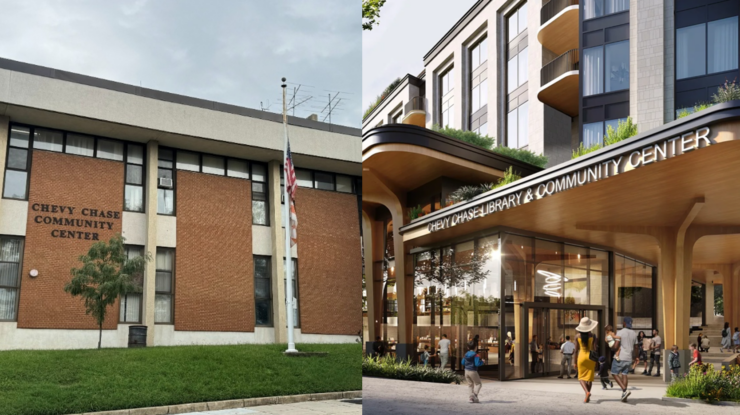
The Chevy Chase Civic Core Redevelopment Plan is a multi-year effort to modernize an existing library and community center, integrate affordable housing, and provide the community with an open space. Its recent 2026 plan includes the addition of 177 affordable housing units with a range of layouts from studios to three-bedroom apartments.
But this influx of 250 to possibly more than 400 new residents would stress and potentially overcrowd Connecticut Avenue’s only Metrobus, D70. Despite a recent comprehensive overhaul of the bus system, the “spine of the community” faces increased congestion from additional commuters during peak usage hours.
When asked about the redevelopment and whether the expected increase in Chevy Chase’s residential population will result in Metrobus D70 frequency changes, the Washington Metropolitan Area Transportation Authority (WMATA) said it doesn’t plan to make any changes to its existing service.
“We would not be adjusting service based on any new development,” Randy Clarke, general manager and CEO of WMATA, told The Wash.
On June 29, 2025, WMATA implemented its Better Bus Network, marking the first major redesign of the region’s bus system in over 50 years. The initiative modernized public transit across the DMV area, and in Chevy Chase, it guaranteed arrivals with Metrobus D70 every 12 minutes or better during peak periods.
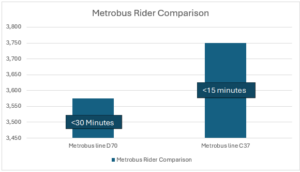
This guarantee has fallen short as recent Transit App data of observed wait times shows the D70, which serves more than 3,500 people on average during the week, reduced its service frequency from less than 20 minutes to less than 30 minutes.
With hundreds more residents expected to move to the area as a result of the new development, Chevy Chase’s main transit line may see similar usage numbers to Metrobus C37. That line serves about 3,700 commuters east of the Anacostia River between Minnesota Avenue Station and Potomac Avenue Station on weekdays but runs 10 to 15 minutes more frequently.
Some Chevy Chase residents recognize the need for better planning around infrastructure, charging that development takes priority and other factors, like transit, are afterthoughts.
“The various agencies that should be brought together to seriously address impacts of development don’t ever study the problem,” said Andrea Rosen, a longtime resident of Chevy Chase. “The greatest good is development, and everybody else is expected to fall in line.”
In January, D.C. Mayor Muriel Bowser officially selected a development proposal from Rift Valley Chevy Chase, LLC, for the Chevy Chase project, prompting the initial discussion of designs in preparation of groundbreaking in 2028, as well as support and opposition.
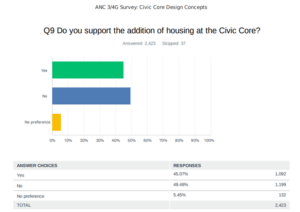
Advisory Neighborhood Commission 3/4G, which represents Chevy Chase, conducted a survey in June 2025, finding that 45% of residents support the addition of housing at the Civic Core while 49% are opposed. Neighborhood representatives highlight the split reactions to the housing inclusion and agree that more information is essential for the community to feel comfortable.
“Just like there was a range in survey results, there will be a range in reactions to the development,” said Laura Phinizy, chair of the ANC 3/4G-04. “At the root, everyone wants Chevy Chase to be the best it can be. Getting down to the root is how we get there.”
The new development is expected to bring in lower-income residents who differ from the historically affluent Chevy Chase, an addition that some housing advocacy organizations support.
“The concern about radical change in the neighborhood is misplaced,” said Ronald Eichner, vice president of Chevy Chase Forward, a social equity and housing advocacy organization in D.C. “It’s important to understand that this effort is using underused public assets [air rights at the civic core] for a public good.”
Francis Griffith Newlands founded Chevy Chase in 1890 as a distinct “streetcar suburb” that maintained its prestige through exclusionary zoning. Today, housing advocates say this affluent community must brace for the changing dynamic in an otherwise spaced-out neighborhood.
“Ward 3 has been exclusionary for centuries due to redlining, racial covenants, and deliberately carving out the land to make it more expensive by zoning it for detached single-family homes,” said Dennis Jing, an organizer at DC YIMBY, a D.C. housing advocacy organization.
“The support [for the plan] is not just housing, but it’s about rectifying historical wrongs,” said Jing.
 Makyla McLeod


Great Article!!!