
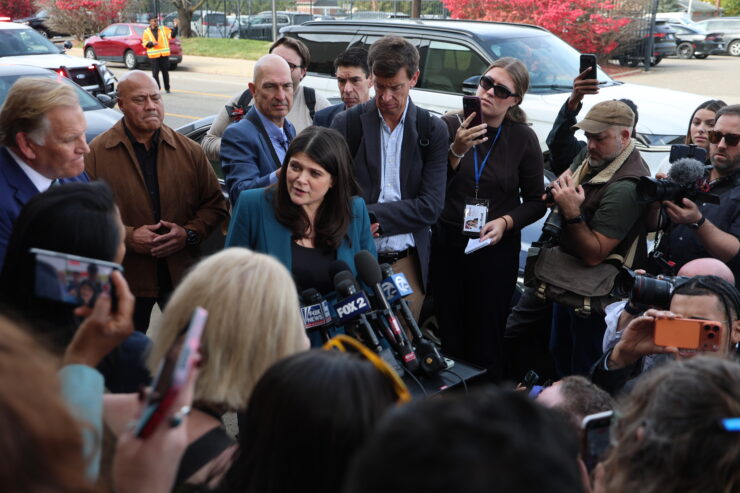
 Deona Easterson
Twenty-three American University students, many with no journalism experience, found themselves covering one of the biggest political developments in Michigan’s closely watched 2026 Senate race.
Just two days before the election, chaos rippled through rows of students sitting in the pews of Second Ebenezer Church in Detroit when a class group message revealed an image posted on X of Democratic primary challenger Haley Stevens, standing alongside Michigan’s Republican Senate candidate Mike Rogers at a church across town.
Unsuspecting students who traveled to Michigan to study electoral politics suddenly became full-time reporters contributing to The Washington Post, working alongside seasoned journalists, like Don Lemon, covering one of the campaign’s biggest political developments.
Congregants of the historically Black church did not utter a word about politics during the Sunday service: hands were up, voices were raised, and amid encouragement from the pastor and choir, the woman in front of the class’s reserved row turned back multiple times to tell the students, “You ain’t seen nothing yet,” echoing the sermon.
She had no idea how right she was.
As the church service wound down Sunday, trip organizer and journalism professor Terry Bryant stole a glance at his phone and abruptly turned its screen to neighboring students.
Within moments, phone glances spilled across the two rows of students gathered in front of the pews. Whispers and confused expressions followed the realization that something extraordinary was unfolding in the contentious Senate race.
The picture of Stevens alongside Rogers at Perfecting Church raised more questions than it answered. With no reporting to explain the unlikely pairing, students suddenly had a story to chase.
As the news spread, students faced an uncomfortable balancing act: reacting to a developing political story while trying not to disrupt the church service they had been graciously invited to attend.
Professor Bryant quickly grabbed his camera gear and began alerting his team of students. Shoulders were tapped like a game of telephone, seizing the attention of his passengers buried down in the pew. “We’re going,” was all Bryant offered as he ushered his group out.
The class had been divided into groups of four or five, each assigned a driver, for the day’s scheduled activities. But the unexpected news quickly disrupted those assignments.
Adrenaline consumed the group, as the rest of the class quickly disbanded to regroup with professors and chaperones outside.
Journalism professor Marina Lopes, who had accompanied the class to assist class organizers Molly O’Rourke and Bryant, sprang into action.
In a frenzy, Lopes shouted, “My van, head to the car immediately.”
Two vans were dispatched to the church where Stevens had appeared with Rogers, while other students scrambled to cover the field for reactions from the Detroit community.
Lopes’ van took off before the team even knew the directions to the church containing Stevens. During the drive, Lopes had 15 minutes to prepare students with a breaking-news 101 crash course.
“If you see Haley Stevens, stop what you are doing, phone up to her face, and directly ask, ‘Are you endorsing Mike Rogers?’” said Lopes.
The scene they were pulling up to would be a leap in the dark. Students had no idea whether Stevens would still be at the church when they arrived, or whether she would even answer reporter’s questions.
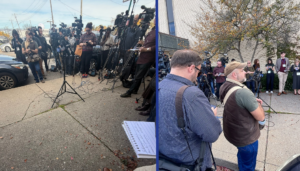
When the van pulled up, students rushed out and found themselves face-to-face with a scene more familiar to CNN’s Kaitlan Collins than to a university class. Not a single person stood outside the church; instead, dozens of cameras lined the sidewalk; one small podium with a couple of microphones perched in front of them chaperoned by numerous reporters.
But not even one of them spoke.
The silence was tangible, and for a few minutes the world seemed to move in slow motion. It was the calm before the storm.
Even Rogers’ team was in the dark. As AU students approached the press pool, one of Rogers’ staffers told The Wash that the campaign had not expected Stevens to appear and did not know whether she intended to endorse Rogers or would speak to the press.
The silence bubble burst as Mike Rogers and Haley Stevens erupted through the doors of the church, surrounded by a swarm of their teams. Lopes immediately pushed students to confront her.
Haider Zaidi, an undergraduate economics and political science student with no reporting experience, shoved to the front of the press pool. He asked whether she was comfortable with Democrats losing their Senate majority over the decision. In response, she brushed it off.
Zaidi was surprised when she answered him.
“I didn’t expect her to respond, especially since she was going to give a press conference in just a few seconds, so why would she answer the questions of a college student who just ran up to her?” Zaidi said.
Why were students in Michigan?
The Battleground courses at American University, designed for both undergraduate and graduate students of various programs, take students to a different ‘battleground’ state each year to immerse them in the world of politics and elections. This includes some field reporting and an opportunity to provide news outlets with updates on voters feelings going into the election.
In previous years, the course has brought students to cover the 2025 gubernatorial race in Virginia and the 2024 presidential primary in New Hampshire.
Organizers chose Michigan as the course’s focus this year, months before they knew it would be the focal point of the midterm elections. Of the roughly 75 students who applied, only 23 were selected to participate in the field reporting experience alongside The Washington Post.
The race between former Wayne County Health Commissioner Dr. Abdul El-Sayed and former Congressman Mike Rogers drew national attention as Democrats raced to gain control of the Senate. At an Oct. 27 rally in Howell, Michigan, Vice President JD Vance called Michigan “the most important election in the United States of America,” and that “more than any other state, it [Michigan] highlights the clash between competing visions of the far-left against commonsense American values.”
Students ran into reporters from around the world at nearly every corner and got to meet journalists from Australia, France, Germany, and several domestic legacy news outlets.
The global spotlight on Michigan this year created an unprecedented situation for both class organizers and students. The class, full of many first-time journalists, expressed surprise at how much reporting they had to do, saying they signed up for the class to get an intimate view into the world of campaigns and politics, which is typically the course’s focus.
O’Rourke validated this surprise and emphasized to the class that usually reporting duties only fall on election day. This year, she had no idea this scale of news would be in demand.
Students reported from sunup to sundown nearly every day on the five-day trip. Reporting at various polling locations for both early and election day voting, at GOP and Democrat rallies, churches like Second Ebenezer, and even in the parking lots and aisles of grocery stores.
Lopes, as the impromptu vignette editor on the trip, said she was receiving texts several times a day from The Washington Post about what they needed from the students. She said she was sending upwards of 100 vignettes a day on the trip.
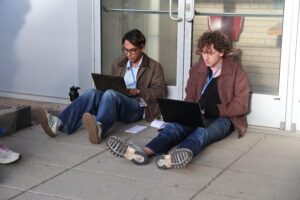
Students were published in The Washington Post a record 21 times, featuring bylines in an international news outlet, The Straits Times, which underscored how important students’ coverage in Michigan was.
The breaking-news aftermath
After the endorsement, students spent the rest of their trip examining how voters felt about the endorsement and asking if it had any impact on voters’ decisions at the polls on Tuesday.
Following the Sunday morning service, students headed to the “Souls to the Polls” rally at North End Church featuring Congressman Jim Clyburn campaigning for El-Sayed.
Members of the press were largely not allowed into the church. However, students outside witnessed a growing press pool that gathered at the entrance, where El-Sayed, Clyburn, and Maryland Sen. Angela Alsobrooks addressed reporters.
El-Sayed urged reporters to focus their questions on the issues affecting Michiganders. However, he was met with pushback on the underlying question of whether he believed Haley Stevens had betrayed the Democratic Party through endorsing Mike Rogers.
“At the end of the day, I actually don’t think about Haley Stevens,” El-Sayed answered. “I think about the nine million 999 thousand 998 people who are not those two. Because you know what? I am just less interested in the politics of it all than I am in the policy of it all.”
Rebecca Wolf, a voter from Detroit, said she felt “awful” about the endorsement.
“It was disgusting, and I feel, honestly, it’s, like—blink twice if you need help, girl, ’cause it feels as though there was something corrupt there. And it feels like a real betrayal.”
But for the students, the surprise endorsement served as a lesson in the adaptability needed for political reporting.
Samuel Stiles-Williams, a political science and communications student, contributed to The Washington Post’s coverage with Zaidi. Working under the stress of covering breaking political news changed his perspective on journalism, despite having no prior reporting experience.
“I think that day was the perfect storm to overcome my own hesitation around journalistic writing,” he said. “That kind of adrenaline, trial-by-fire moment can never be replicated and gave me the greatest writing lesson of my life.”
Neil Lazurus, Jessica Ackerman, and Ellie Knudson contributed to this report.
 Alyssa Summers
 Isabella Barias
 Nia Ames
 Celeste Hoytt
 Ashayla Byrd
 Birchard Allen


Add comment