

 Birchard Allen
Black history has been a target of the Trump administration, as it pressures the Smithsonian Institution to remove exhibits that is considered not portraying US history in a positive light.
However, these institutions have been fighting back and have not yet removed any exhibits.
But educating and defending black history isn’t always a protest; it can happen at a comedy show, too.
 The live show and podcast, “Drunk Black History,” came to D.C. this past month, bringing to D.C.’s Penn Quarter a blend of education and humor that highlights the achievements and untold stories of black historic figures.
The show was recorded Sept. 18 at Penn Social on E Street, NW, just a few block from the National Museum of American History and the National Museum of African American History and Culture, which celebrated its 10-year anniversary on Sept 24.
Both museums are facing executive orders from President Donald Trump to remove certain exhibits from their institutions that represent history of social activists, people of color, the LGBTQ community, along with many others.
Brandon Collins, creator and host of “Drunk Black History,” emphasize the importance of education of different cultures.
“History’s important, and it’s going to die if we don’t continue remembering it and pushing the knowledge forward,” Collins said.
Drunk Black History is on tour across the country, doing shows with many special guests to educate and tell the truth about African Americans. All live shows can be watched on the YouTube channel, @drunkblackhistory.
Upcoming shows are scheduled for New Orleans, New York, and Charlottesville, Virginia.
The show provides an angle of history and culture in an educational way, but also with a balance of comedy. Collins said he believes “a laugh is more memorable than some of that just given to you via textbook or PowerPoint presentation or a lecture” when celebrating black history and culture through a comedy show.
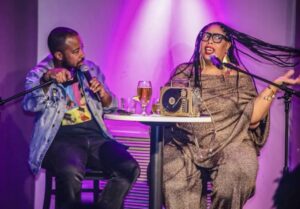
“These myths and distortions that have been told about Black Americans for so long have now been believed that people take them as a fact,” said Sherri Williams, associate professor of Race, Media and Communication at American University. “That is why it is important for the truth to be told and to be taught.”
Williams was a special guest at the Drunk Black History show in D.C. and focused her remarks on Dorothy Butler Gilliam, an important journalist who Williams said is not well known. Among other positions, Gilliam was the first African American woman to be hired by the Washington Post.
“She was a witness to history, and she’s also someone who experienced horrendous racism. There were many times in her career and her life she could have quit, but she didn’t,” said Williams.
Williams said she wasn’t surprised when she heard about how the Trump administration is affecting cultural institutions in the D.C. area.
She noted the number of people that come to D.C. each year for field trips and tourism. Williams reminisced back to when she was in high school and her school would raise money to take a field trip to D.C. to see the highlight Smithsonian museums which “marvels the greatness that is all of this nation.”
“Now when they do arrive in Washington D.C., they will see a distorted and deflated version of history, and I think that’s a disservice to the entire country,” said Williams.

The Smithsonian has resisted the administration’s executive orders. As a result, President Trump has demanded signs be placed in front of the museums calling attention to what he claims are inaccuracies.
Dawn Chitty, director of education at the private African American Civil War Memorial Museum, said this news was a “direct hit” to her, coming from a family background in the United States military, giving back and serving to this country.
“It’s a lot to process. On one hand you have this administration has said that they want to correct erroneous information that has been given out to the public. And on the other hand, it’s this whole thing about DEI,” said Chitty.
Chitty said African American history has been taught just a section of the full American story.
“It’s a portion of the American story instead of being just the American story, said Chitty. “I think we do ourselves a disservice by not appreciating all of those different facets, their beauty, and their color, which makes America, America.”
Williams agreed.
“Educational institutions in America should teach students the truth about Black Americans. The truth is not that our stories here began with slavery. Theres a lot more to the story.”
Williams said she is concerned about the attacks on Black culture beyond the classroom, especially when cultural institutions like the NMAH and the NMAAHC face orders to change how stories, cultures, and identities are presented.
“I think that it is a real devastation to the historical record in this country to have it be distorted in this way,” said Williams.
A visitor at the NMAAHC, Antonio Davis, emphasized the importance of the education in cultural institutions, specifically pointing out the lower level of the museum that is “overlooked” in his eyes.
“This level focuses on what our changing America looks like. There is a lot of important information about it down here that I think a lot of people miss over,” Davis said. “People should take their time and receive the education they are missing out on.”
“It’s not just the limited few folks like Jackie Robinson, and Ruby Bridges,” said Collins. “There are so many people, so many black people that have had a huge impact on all facets of culture and life.”
The AACWM has undergone a renovation and will reopen to the public Wednesday, Sept. 30. The museum is located at 1925 Vermont Ave NW, Washington, D.C. 20001.


 Luisa Clausen


Add comment