
 Lauren Andreala
The start of the school year leaves Navy Yard residents unsure whether any changes will be made to the area’s youth curfew.
The D.C. Council enacted the Youth Act Amendment of 2026 on July 6 to combat the increasing amount of youth violence. The act allows the mayor or chief of police to add curfew zones if deemed necessary. This applies to youths under 18 years old in groups of nine, in public areas, and any establishments within the zones.
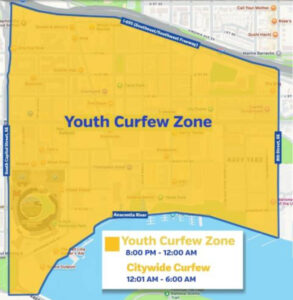
Navy Yard had additional zones implemented on specific weekends this summer, including June 12-14 and Labor Day weekend. The curfew would start at eight p.m. on Friday and run through eleven p.m. on Saturday.
Despite the act being active in Navy Yard for two-months, residents are unsure about how effective the law has been.
Haley Climman understood why the council implemented curfews, but she said there was a better solution to keep the community active without punishing youths for going out and being social.
“I think shenanigans can happen at any hour, so a curfew doesn’t really change things,” Climman said.
Lily Miller, the director of the Youth Justice Division at the George Washington Law School’s Access to Justice Clinic, said that teenagers testified to the Council when the emergency amendments were implemented, asking for recreational centers and boxing gyms where they could socialize with friends.
“Congregating as a group shouldn’t be a basis for criminalization,” Miller said.
Teens do not have enough safe spaces to socialize with friends, and school won’t have any effect on whether the laws are effective, according to Miller. These laws were put in place due to property values, rather than focusing on the safe spaces youths need, she said.
“I feel like it is putting a Band-Aid on a more systemic issue,” Navy Yard resident Jamie Robinson said.
Robinson agreed with Miller, saying the real issue at hand was the lack of spaces for youths. He said the community should focus on creating more spaces where youths can socialize, adding that curfews only create a short– term solution to a long– term problem.
The research shows zones may move youths from one zone to another, but there is no indication curfew laws reduce crime, according to Michael Umpierre, the director of the Center for Youth Justice at Georgetown University’s McCourt School of Public Policy.
Additionally, curfew laws deepen the distrust between law enforcement and community members, Umpierre said. When the community deems a new policy as unnecessary, and allocates resources from other immediate issues, tension grows, he said.
He said that the Council should focus on strengthening policing community relations, instilling positive social after school activities, and improving community safety.
Another important goal should be reconnecting students with school, said Deborah Shore, the founder of the Sasha Bruce organization. Ever since the COVID-19 pandemic shut down schools, opting for online school during the pandemic, she said she has witnessed students struggling to re-engage. Not only with learning, but with each other.

The combination of the lack of places for youths to socialize, the struggle with interacting at school, and curfew laws lessens community engagement, according to Shore. By having more programs, students can learn how to apply their own passions to a community.
Councilmember Trayon White, Sr. and his team declined to comment.


 Ashayla Byrd
 Alyssa Summers
 Makyla McLeod


Add comment