
 George Smith
RICHMOND, Va. — Covering the Virginia governor’s race as a British graduate student felt like stepping into a living experiment in democracy. In the U.K., elections are brisk. Four to seven weeks of leaflets, a few polite hustings and everyone goes back to complaining about the weather. In America, politics is theater. The rallies have theme music, the crowds wear slogans and the flags are big enough to upholster the Palace of Westminster.
Our Battleground Virginia class at American University spent four days on the campaign trail — a mid-semester field experience to complement our in-class lectures — and what I found wasn’t just spectacle. It was a system in which forgiveness depends on your last name, as one candidate’s comeback would later show; where churches double as campaign headquarters; and where voters have stopped trying to persuade each other and started wearing their politics like their identity.
The divide was stark. Every event felt like a world apart. Red or blue, never both. At least in the U.K., people tend to put their national identity above their political one. In America, political identity often comes first.
The Sermon and the campaign.
Saturday began with former President Barack Obama’s return to Norfolk to endorse the then-candidate for governor, Democrat Abigail Spanberger. It was less a political event than a cultural pilgrimage. The crowd sang, danced and cried; “hope” wasn’t just a word but a rhythm. Having studied political oratory, I watched Obama like a craftsman watching a master, the balance of humor and seriousness, the control in his pacing, the pauses between applause lines. His tone was hypnotic, equal parts sermon and stand-up. He didn’t just deliver a speech. He conducted a symphony of belief.
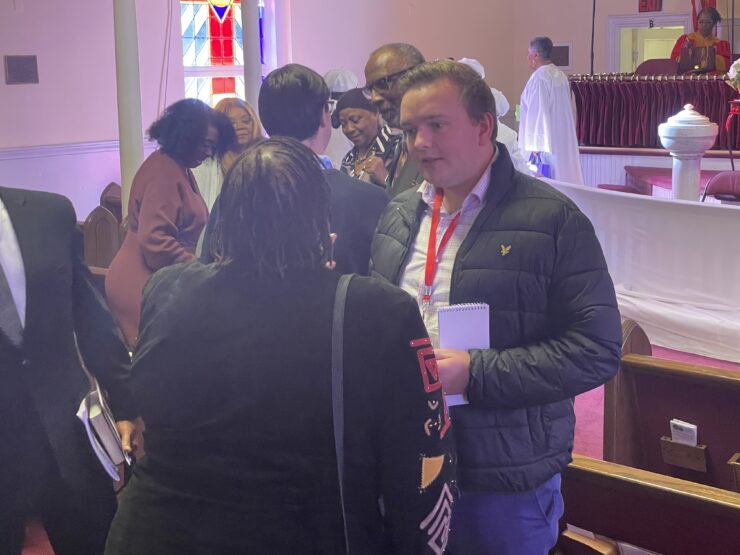
The next morning, we were in Richmond, seated among the congregation at Third Street Bethel A.M.E. Church, a historic African American church with a long tradition of civic action. The Rev. Reuben Boyd’s sermon wove scripture and politics seamlessly. “There are no kings here,” he declared, to a chorus of amens. Church leaders spoke about plans for a March on Washington next year, faith mobilized into activism before our eyes.
Afterward, Gwen Faush-Carney 49, a member of the Delta Sigma Theta sorority, told me; “Through life’s experiences, God helps guide me. I’m independent when it comes to voting, but I share our church’s values of faith and service.” When I asked what that meant in practice, she smiled. “It means I vote Democrat, but I think about it first.”
In Britain, we keep faith and politics in separate pews. In America, they harmonize. The church isn’t just where you worship. It’s where you organize.
Liberty and the costume.
By Sunday afternoon, we were in Hanover County, where the Republican candidates for governor, attorney general and lieutenant governor rallied supporters alongside outgoing Gov. Glenn Youngkin. It felt less like a campaign event and more like a homecoming. “Don’t Tread on Me” flags flapped above the crowd. One sign read. “Democrats: your use of hatred has produced evil. Who will vote for you?” The rally felt aimed at the faithful, not the undecided.
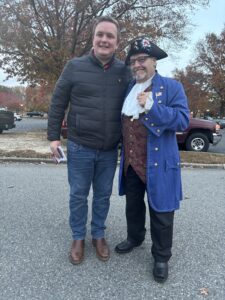
Among the crowd was a man dressed as Patrick Henry, 71, complete with a tricorn hat, who cheerfully introduced himself as the original Virginian patriot.
“He’s here every time,” laughed Charlie Waddell, 68, a substitute teacher and former local official. “The costume doesn’t change, and neither do the speeches.” Then, with a shrug, he said, “They love Trump. That’s the glue.”
Roger Martin, a retired engineer attending his first rally, summed up the mood perfectly. “Spam is bad for your computer. ‘Spamberger’ is bad for Virginia.” He laughed, then said of the Republican candidate, Winsome Earle-Sears, “She stands for Trump, that’s enough for me.”
For a Brit, it was fascinating. American conservatism doesn’t do understatement; it comes draped in banners and conviction. Where British Tories mutter about heritage, Virginia Republicans shout about liberty.
The name brand.
On Monday, we met Don Scott, a Democrat and speaker of the House of Delegates, who mixed gravitas with good humor. The conversation turned to Jay Jones, the Democratic attorney-general candidate who had sent threatening texts to a Republican rival years earlier but remained on the ballot.
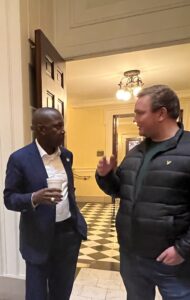
Scott defended Jones as a “good man who made a mistake” and questioned why the issue of his violent messages, recently published by The National Review, had lingered so long. Then came the telling line: “Jay’s dad was part of the Democratic establishment. He’s got a name brand. People know the Jones family.”
That night, Jones won comfortably. For an outsider, it was jarring. In Britain, a scandal like that would end a career. In America, or at least in Virginia, it’s a speed bump if your family has enough political capital. Tribal loyalty isn’t a bug. It’s the operating system.
Democracy as expression.
Election Day arrived, and students were dispatched to polling sites across Richmond and Norfolk to capture the mood of the electorate and file their notes and vignettes to The Washington Post. Outside Clover Hill High School, a leafy suburb of Richmond, Jenny Mylott, a 55-year-old accountant, called the vote “a referendum on Trump.”
“We get government contracts, and now our company isn’t getting paid,” she said. “I’m hoping this election makes Washington wake up and compromise. It just cannot be a single person controlling everything.”
Across town, Tony Clark, a 20-year-old student, offered a different angle.
“The campaign felt like it was run back in 2008. But this vote was a symbolic middle finger to D.C.”
Both saw their ballots not as civic duties but as acts of expression, one weary, one defiant, both deeply personal.
Victory and exhaustion.
When results night arrived, I joined the crowd at Spanberger’s victory rally in Richmond at the convention center, which buzzed with exhaustion and elation. When Spanberger finally took the stage, she thanked voters and her family and even teased her youngest daughter for not cleaning her room, a small, human moment that cut through the political theater.
To some, she was a centrist pragmatist; to others, she was simply “not Trump.” In that room, those differences dissolved. Democracy felt tangible again, messy, noisy, occasionally absurd, but unmistakably alive.
What Britain doesn’t understand.
For a Brit abroad, the lesson was clear. In America, politics isn’t a conversation; it’s a calling. Faith groups mobilize, students organize, retirees proselytize. It’s less about left and right than about belonging, a contest not of policies but of identities.
The British system, for all its dullness, at least maintains the pretense of propriety. In America, standards are negotiable if you’re on the right team. But for all its flaws and theatrics, American democracy is gloriously alive. People shout because they care. They argue because they believe the system is still worth arguing over.
Loud, restless and endlessly unfinished, America’s democracy may not be tidy, but it is alive in a way Britain’s rarely feels.

 Wash staff


Add comment