
 Celeste Hoytt
 Alyssa Summers
 Wash staff
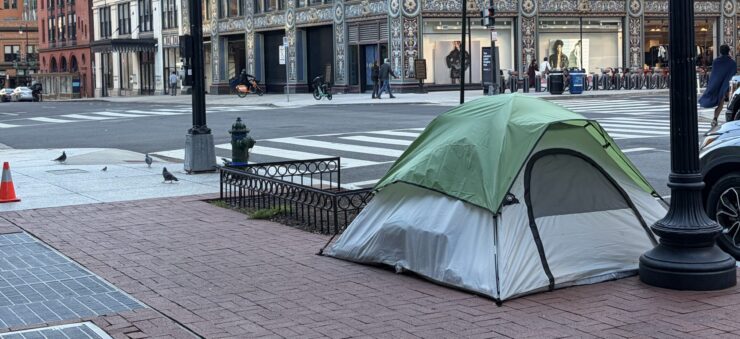
D.C. Mayor-elect Janeese Lewis George will take office on Jan. 1 promising to build 72,000 homes and stop clearing homeless encampments across the District, as rising costs push more families out of their homes and onto the street.
On Monday morning, a tent, cots, and piles of suitcases lined the sidewalk outside of Martin Luther King Jr. Memorial Library on G St. NW, less than a mile from the John A. Wilson Building, where Lewis George will soon govern.
D.C. residents and visitors in layers of warm clothing stepped around the encampment as D.C. prepares for a freezing East Coast winter.
Danesha, 48, has lived on the streets for two years. She said rising costs priced her out of the city’s apartment housing, and full shelters left her with nowhere to go.
“With how expensive everything is, I’m glad my parents aren’t alive anymore, because they would be out here with me,” she said. “None of the people truly want to be out here unless they turn to drugs, but what choice do we have?”
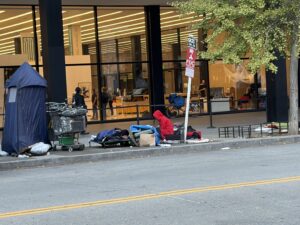
The city needs better housing programs, she said, because the number of unhoused individuals keeps rising, while the number of shelters in the city stands still.
The city’s own numbers back her up. According to 2026 data from the Executive Office of the Mayor, on a single night, D.C. counted 5,363 people experiencing homelessness, 4.4% more than the year before. Family homelessness rose by 15.8%, driving much of the overall increase.
The shelters in D.C. have not been able to keep up with the demand.
According to Street Sense Media, there are only 1,130 beds available year-round at D.C. homeless shelters across the city.
Adding beds and reversing that trend will cost money, and Lewis George will have less of it to spend.
According to the Washington Sun, the city faces a projected $600 to $800 million structural deficit, a gap that Mayor-elect Janeese Lewis George aims to close with internal government efficiencies, savings, and agency desk audits.
Despite the tight budget, she has made housing the centerpiece of her plans for the city.
Mayor’s Two Promises
Lewis George has built her housing agenda on two promises.
Her “Housing for All” plan calls for 72,000 new homes in the next five years by easing construction near public transit, schools and parks, and creating mixed-income housing through an initiative called “Dignified Homes D.C.”
That target already faces skepticism. Developers told Bisnow that reaching it will require private investment, at a time when new housing construction has hit an all-time low. It would also expand rent control, limiting the construction of new buildings.
Her second promise is to stop clearing encampments, “without a stable pathway to permanent housing” in a candidate questionnaire by Street Sense Media in 2026.
Her encampment pledge is a clear break from Bowser’s, whose administration cleared camps in Noma, McPherson Square, and other populated areas in the city which raised criticism from advocates.
According to Street Sense Media, the city shut down 98 encampments through July of this year, nearly double the 50 closed the previous year.
Mayor Lewis George’s team did not respond to a request for comment.
Beyond A Roof
Some who work directly with the unhoused population in D.C. say housing alone will not necessarily solve the problem.
Joseph Mettimano, president and CEO of Central Union Mission, a faith-based, nonprofit that serves the unhoused community in the DMV, said a lack of affordable housing and livable wages plays a significant role, but many people the mission serves also struggle with mental health and addiction.
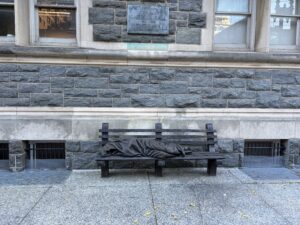
“Simply putting a roof over someone’s head does not solve the root issues that put the person on the street,” Mettimano said.
The programs that work, he said, combine stable housing with “requiring recipients to participate in programs that address the issues that put them on the street.”
“Both are required,” he said.
He also called for job programs in the skilled trades, which he said, “pay a livable wage to people who may be uneducated and where there is great demand.”
An Inherited Budget
Lewis George will start her term under outgoing Mayor Muriel Bowser’s fiscal year 2027 budget, which sets aside $246 million for permanent housing programs serving 9,000 households and $13.42 million to prevent homelessness.
Advocates said the budget isn’t enough. Amber Harding, executive director of the Washington Legal Clinic for the Homeless, told the D.C. Council in May that the proposed budget’s message was that, “unhoused people are not welcome in D.C.”
Following pressure from advocates, the council later restored many of the programs Bowser had proposed cutting and passed the budget unanimously.
Bowser refused to sign it, warning that “funding ongoing programs would leave the next mayor and council with a $837 million fiscal cliff.” The budget took effect on Oct. 1 despite pushback.
Lewis George, who represents Ward 4, has opposed cuts to budget and social programs.
She will also have to work with the D.C. Housing Authority, which runs the city’s voucher program and is under its own financial strain.
At a Sept. 29 council meeting, the city auditor said the agency may have failed to account for $52 million in expenses and faces a $62 million budget shortage. Councilmember Robert White, who chairs the housing committee, said the committee will hold monthly meetings with auditors to monitor the agency’s spending going forward.
Lewis George’s first budget will not arrive until spring 2027.
Until then, Danesha said she leans on the people around her.
“Luckily D.C. has a homeless community, so I don’t feel alone,” she said. “But it’s hard.”

 Jacob Saucier

 Lauren Andreala
 Kayden Anderson


Add comment