
 Wash staff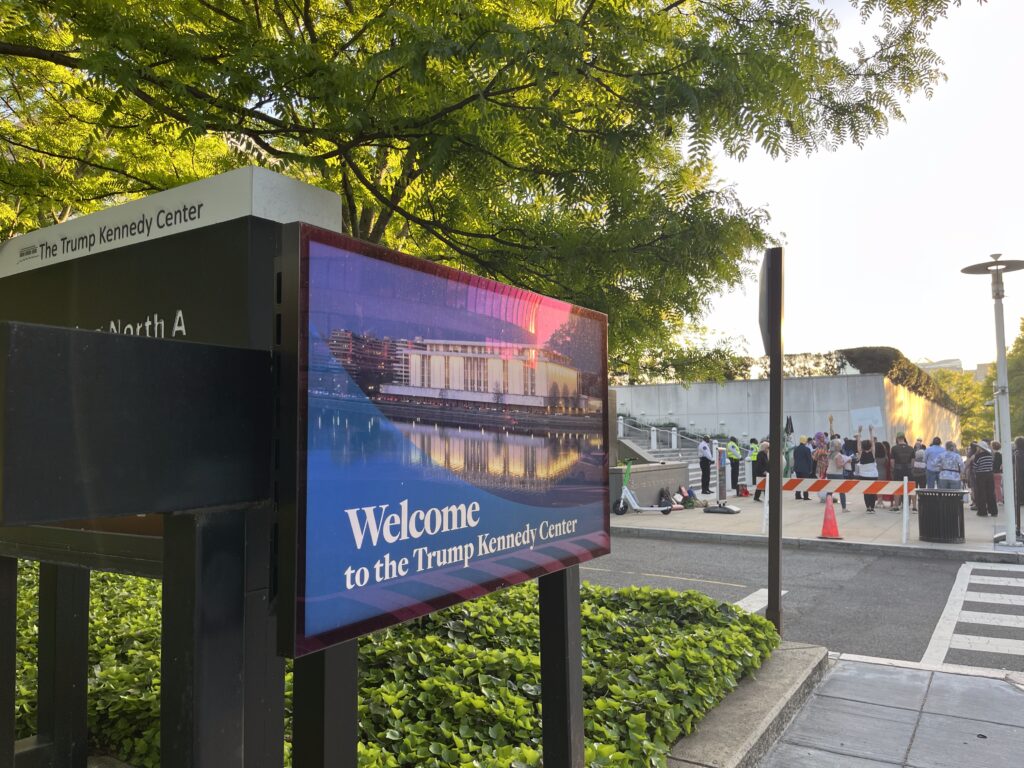
By Yuri Perelman
When Thea Kano was younger and growing up, she questioned where in the world she would like to perform music as a conductor. The Kennedy Center always came to mind, she said, because of its perception as the nation’s stage.
The John F. Kennedy Center for the Performing Arts had a lengthy development. It opened to the public on the evening of September 8, 1971, according to a New York Times story published the following day. Roger L. Stevens, then chairman of the board, wrote to Congress the following day that the center’s “promise and purpose” would be to strengthen the life of the performing arts throughout America and all they can give to all Americans.
Stevens also gave a speech on the center’s opening night explaining that the center was dedicated as a memorial to Kennedy, and the only such one in Washington. Today, the chairman of the board is President Donald Trump himself.
Today, Kano is Artistic Director of the Gay Men’s Chorus of Washington D.C. She is one of many engaged in performing arts in Washington D.C. that have been inspired by the Kennedy Center from a young age who also disagree that Trump’s actions towards the center have not been appropriate, or faithful to the intentions of those involved in its development.
Artistic organizations face pressure
Trump has had a heavy influence since taking the role of board chairman.
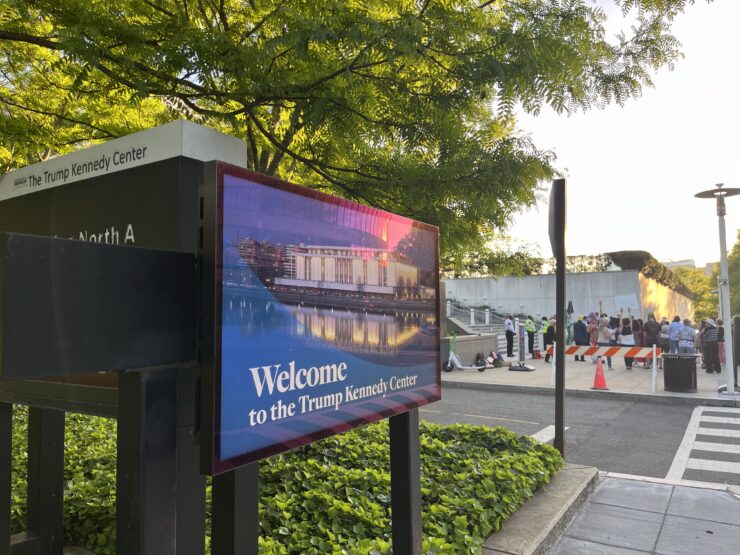
The Kennedy Center, now branded the Trump Kennedy Center, has been targeted by the administration for the quality of its facilities. Consequently, The center will be closing for two years to undergo a complete reconstruction, starting on July 4.
Groups like the National Symphony Orchestra, whose primary performing venue is the Kennedy Center, are going to have to find alternative locations to perform at during this period.
Lola Zulps, an alum of American University’s College of Arts and Sciences and former operations intern with the NSO, finds it unfortunate that the city will lose its largest cultural hub. But she observes that by performing in local venues, a silver lining is that the orchestra will be able to connect with the D.C. community on a deeper level.
“I do think the Kennedy Center closing allows us to reach more people, and for people to be more connected to us and more willing to see us in a show,” Zulps said in an interview.
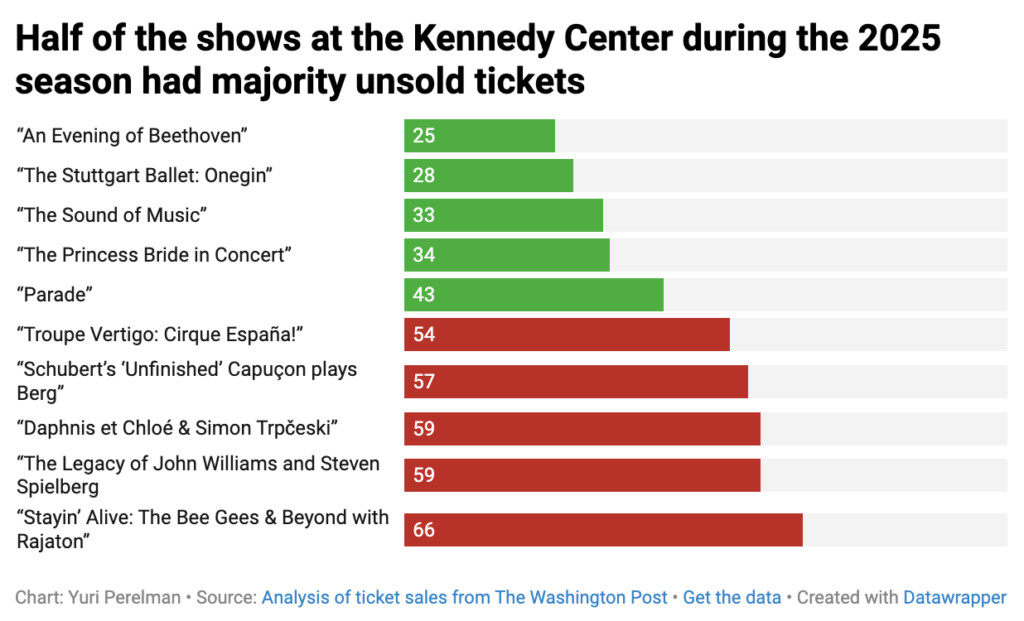 Zulps also notes that by being able to disassociate itself with the president, the orchestra has a stronger chance of regaining patronage it has lost since Trump began making alterations to the Kennedy Center.
“We’re hoping that when the shutdown happens and we’re on the road and we’re performing at all these other venues, we get our audiences back, because we’re not affiliated with that center anymore,” Zulps said.
Andrew Taylor, the director of the Arts Management program at American University, says that the closure of the center will bring substantial challenges to the orchestra. Finding a suitable venue, with the proper acoustics for the large orchestra, will be difficult.
“It’s hard to beat the Kennedy Center for the quality and stature and credibility,” Taylor said in an interview. “The audiences tend to think, Oh, it’s gonna be good if it’s in that space, and the acoustics are great, and the building is great. So it’s hard to find comparable venues.”
Taylor projects that by not being able to perform in the Kennedy Center, the orchestra will see fewer performances, fewer contracts, less musician hours, and fewer opportunities for people to see them.
There will also be a reduction in job opportunities for performing arts in the D.C. area.
“Performers will have less opportunities to perform,” Taylor said. “All of the stage professionals and the craft professionals and the technical and sound and audio and engineering. Everybody who makes a show happen, will have a significant reduction”
In the meantime, the nature of programming at the Kennedy Center has changed. Many events with LGBTQ themes are no longer taking place. The Gay Men’s Chorus, as an example, was scheduled to accompany the National Symphony Orchestra during a show in June 2025, until the performance was abruptly canceled.
However, Kano also says that the Kennedy Center has changed so much as an institution, and is a hostile place for groups like the Gay Men’s Chorus.
“We do not feel welcome there even if the doors remained open,” Kano said.
Artists protest the changing of a cultural center
When Donald Trump attended the Kennedy Center’s premiere of Les Misérables, he sat in a theatre that was mostly empty. Senator Ted Cruz and far-right activist Laura Loomer were among the few in attendance. But also in the audience were three drag queens.
One of them was Tara Hoot, a drag artist whose stage name was derived from their hometown of Terre Haute, Ind. They recalled that this act of protest was highly effective, going on to garner media coverage from outlets like the New York Times.
“It was pretty empty inside, but we got a pretty good applause, and we just wanted to show up as a form of protest and take up space,” Hoot said in an interview.
Today, Hoot serves as emcee of a weekly demonstration organized by advocacy group Hands Off the Arts. Every Friday evening, a group gathers in lively song and protest on the steps leading up to the entrance of the Kennedy Center.
Hoot says these protests are important because it is difficult to predict the extent to which the Kennedy Center will change after Trump’s planned reconstruction.
“I don’t trust Donald Trump,” Hoot said. “He tore down the East Wing of the White House without anybody batting an eye. And, you know, he doesn’t listen to any moral compass or have any rules or follow any rules. So, you know, if the Kennedy Center closes, what’s to say that we wake up one morning and it’s not there anymore, physically?”
Many involved in leadership positions with Hands Off the Arts have personal connections to the center that drive them to the cause. Mallory Miller, an alum of American University’s College of Arts and Sciences and the organization’s co-founder, studied classical ballet from her childhood through college and says the existence of the Kennedy Center has always been very profound to her.
“I grew up in central Indiana, and I became aware of the Kennedy Center when I was very, very young, and understood that I could have a career because a place like this existed,” Miller said in an interview.
Forrest Robinette runs Hands Off the Arts’ arts and community outreach committee, and is a former tour guide at the Kennedy Center. He observes that the closure of the Kennedy Center is going to be especially devastating for the Washington D.C. community at large, pointing particularly towards those who benefit from their educational programs.
“Many of these students are not students who would go see the ballet normally,” Robinette said in an interview. “They are not students who would go see the symphony normally. They are not students who would engage in performing arts normally without this.”
Looking towards the future
Some of those who currently work within the Kennedy Center, like Zulps, have encouraged an optimistic outlook.
“It is so, so important to continue playing and to continue putting on shows, and to keep doing what we’re doing with our heads up, and keep moving forward,” Zulps said. “Because if we don’t do that, then what?”
After all, Zulps said, artists won’t be unsupportive during this period.
“We’re not under his name, and we know that we have support, and we know that there are people rooting for us,” Zulps said. ”We just have to get through this difficult time.”
This mindset was pushed back somewhat by Hoot.
“I think that the people that are optimistic are, I don’t want to say delusional, but I’m not nearly as optimistic thinking about if the Kennedy Center closes, that it’s going to open up and be what it was before,” Hoot said.
But Hoot has a word of advice for those who are concerned about how the arts scene in Washington will cope.
“Don’t lose hope,” Hoot said. “If I can throw drag on in two hours and get down there every single Friday to try to make a difference, and to show up on Capitol Hill, and to do this. I mean, showing up is the least that people can do right now.”




Add comment