
 Kayden Anderson
Not many people can visit an Egyptian art exhibition in the United States because of their rarity and difficulty staging.
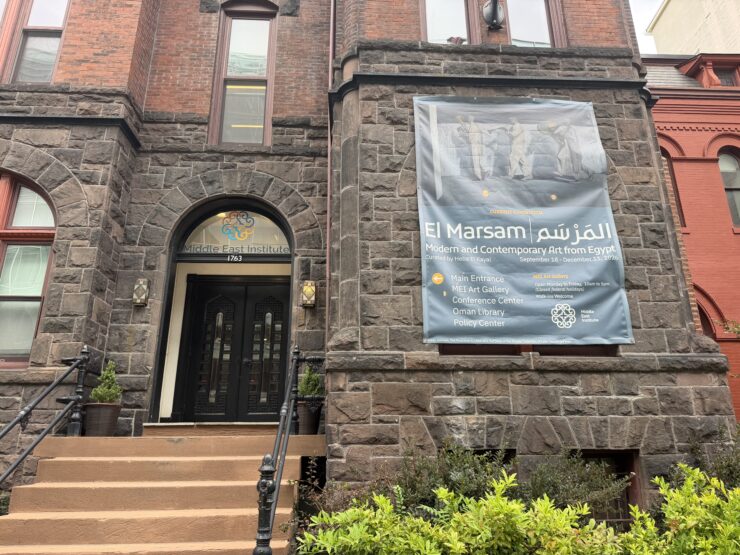
But D.C. residents now can. “El Marsam: Modern and Contemporary Art from Egypt” just opened at the Middle East Institute in Dupont Circle.
“It’s not every day that there are exhibitions that focus on Egyptian art,” Nour Kamel, who visited the exhibition on its opening day, said. “As a matter of fact, I don’t know of any other one that just focused on Egyptian art.”
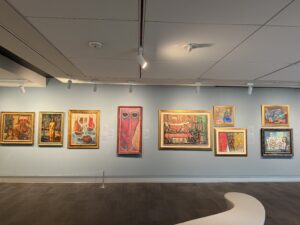
The public can view the artwork for free any time the MEI is open, Monday through Thursday from 10 a.m. to 5 p.m.
The gallery, which is located at 1763 N St NW, premiered Sept. 18 and will be open until Dec. 11.
But the planning began almost a year before.
Lyne Sneige, senior director of the MEI’s Arts & Culture Center, said the idea for the show sparked, just like any other exhibition: through conversations.
Collectors and lenders in the circles of the MEI helped make the gallery happen, Sneige said. Then, they identified a curator, London-based Heba El Kayal, who is well-versed in the Egyptian modern and contemporary art scene.
“We do a lot of programming at the intersection of arts and policy, and arts and society, and arts and politics, so we’re embedded in that,” Sneige said. “We’re not your regular gallery.”
Sneige said the Arts and Culture Center, which was established around 2019, has hosted more than a dozen shows. And all of them have a social, economic, political angle.
Their mission, she said, is to stay embedded in the overall institute.
The MEI is a think tank that engages with U.S. and Middle East relations. According to its website, it delivers “nonpartisan insights, analysis, and recommendations to thought leaders and policymakers.”
Alex Dika Seggerman, an associate professor of Islamic art history at Rutgers University-Newark, said the show is a “pretty big deal.” Seggerman is the author of “Modernism on the Nile: Art in Egypt between the Islamic and the Contemporary” and has focused on modern art in Egypt for almost two decades.
She said it is not as common to see modern Egyptian art in the U.S. originally because of a bias towards Europe and America, but now, it is due to expenses.
“Most of these collections are based abroad, and it’s really hard to facilitate loans of artworks from Korea or India or Pakistan to get to the United States,” Seggerman said. “It takes a lot. You have to put it on an airplane, and it has to be in a special box, and it has to have insurance and all that stuff, so it’s less likely to happen.”
That was an initial hurdle for the MEI.
“It was very costly, of course, but we have overcome that because we found people who were committed enough to want to showcase modern and contemporary Egyptian art in an international setting and the importance of that,” Sneige said.
Since its opening, Sneige said the public reaction to the show’s more than 45 pieces of art has been positive.
She said some feedback they have received is that “El Marsam” is a museum-level exhibition in a small gallery in D.C., and that it’s “like a gem.”
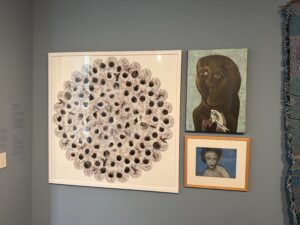
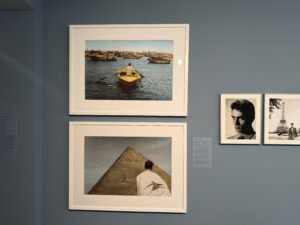
Kamel is the director of partnerships and communication at a nonprofit in D.C. but is from Egypt. She said she thought the exhibition was well-curated and brought together a diversity of mediums, including sculpture, painting, and photography.
“One thing that, for me, really stood out is that, other than the fact that there’s a very wide range of artists, both men and women, there is a relationship between some of these artists, which is so lovely to see one person being a mentor to another person,” Kamel said.
Sneige said the Arts and Culture Center hopes to host a panel with one of the artists, screen a movie, and have an event with a brand from Cairo.
Kamel plans to visit the gallery again, and she thinks it is important the art work is in D.C. She said, the district is a place where culture is valued and diversity is appreciated.
“I think to bring this art here is to make it accessible for many who wouldn’t otherwise have access to it,” Kamel said.
 Lauren Andreala


Add comment